

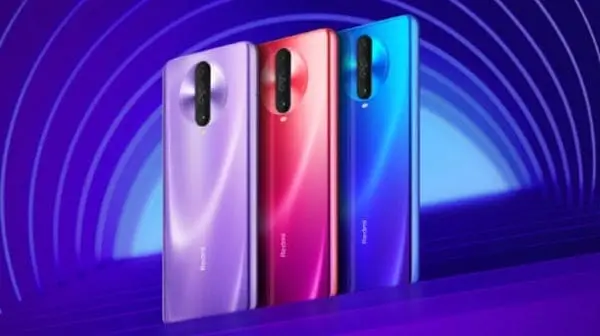

A few days ago, Redmi officially released the Redmi K30 series. However, the punch-hole design has been a topic for discussion. The yellowing of the punch-hole camera has been a major concern. In this regard, Lu Weibing, general manager of the Redmi brand, gave his comments on the Redmi K30 series design.
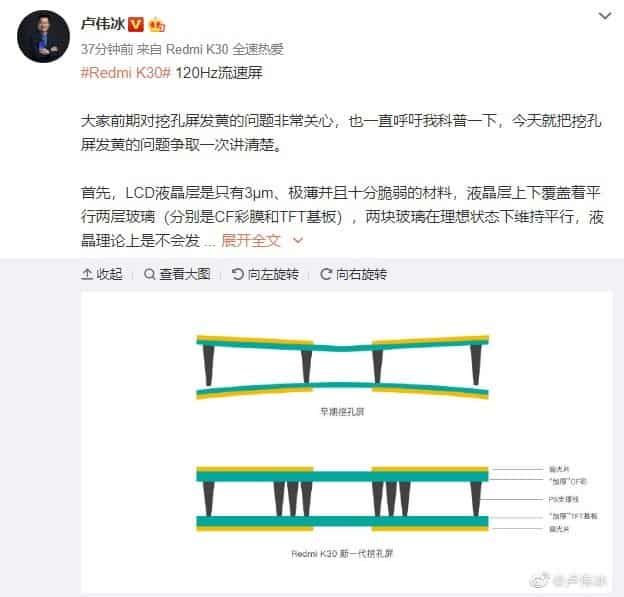
According to Lu Weibing, the LCD liquid crystal layer is only 3μm, very thin and very fragile. The liquid crystal layer is beneath two parallel layers of glass (CF color film and TFT substrate). In the state of maintaining parallel, the liquid crystal theoretically does not yellow. However, when the parallel state of the two layers of glass is broken, the screen will yellow when the uniformity of the liquid crystal changes.
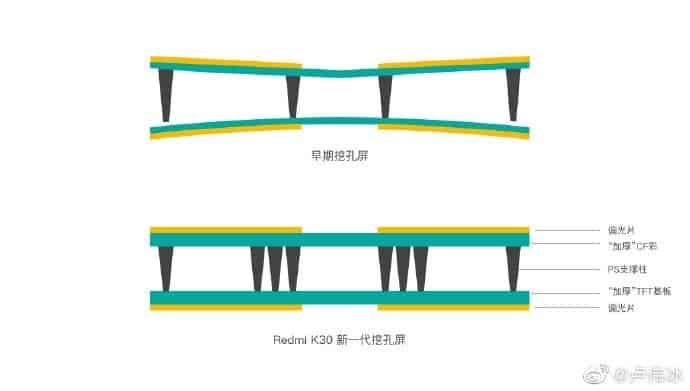
In addition, Lu Weibing listed the two major advantages of the new generation of Redmi K30 punch-hole screen:
- Upgrade “thickened glass”. Two layers of glass are strengthened to increase the overall thickness by 14% and increase the structural strength;
- Increase the density of support columns. A large number of PS support pillars are added around the hole, and the density of the support pillars is much higher than that of ordinary screens, ensuring the stability of the two glass structures around the hole.
Furthermore, Lu Weibing said that the Redmi K30 uses new processes including low-shrink polarizers and upgraded dispensing technology. These allow the screen structure to achieve long-term stability.

Place comments
0 Comments
You are currently seeing only the comments you are notified about, if you want to see all comments from this post, click the button below.
Show all comments